








‘500’ Reality Sinks In for Felix Rosenqvist After Seeing Borg Likeness

Eric Smith
INDYCAR Staff Writer
SEP 23, 2026
Felix Rosenqvist traveled to Tryon, North Carolina, this week to see his face that will be added to one of the most exclusive pieces of hardware in motorsports.
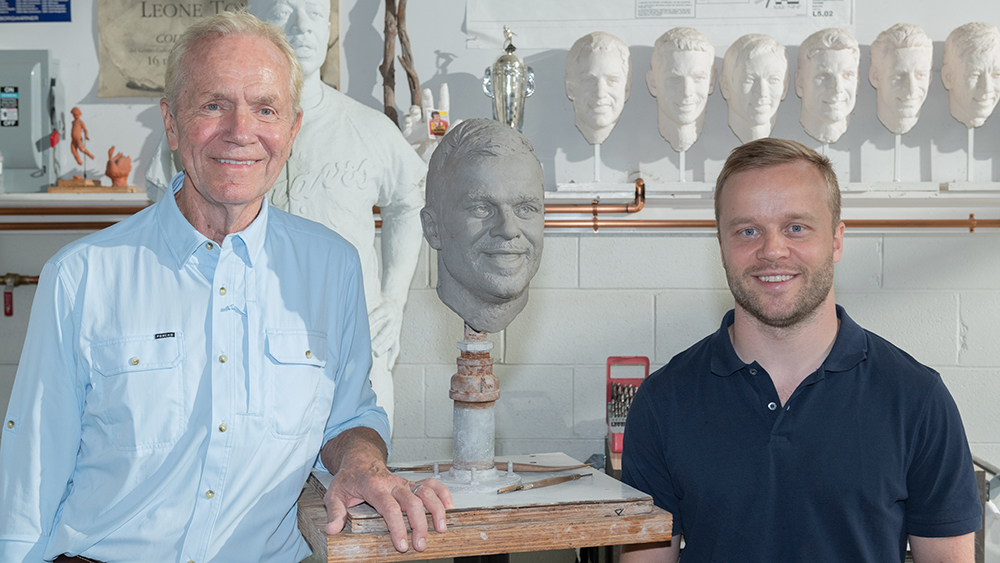
On Sept. 22, artist William Behrends unveiled Rosenqvist’s sculpted clay likeness that will serve as the bas-relief portrait on the Borg-Warner Trophy. The iconic hardware carries the likeness of every Indianapolis 500 winner, creating a visual history of the race dating to its inaugural running in 1911.
“It’s been quite the experience,” Rosenqvist said. “Such a cool, unique little trip here, getting to meet Will (Behrends) and his family. It’s kind of a rare thing to experience. I never thought I would be sculpted. I think it’s not a thing people really expect to do in their lifetime.
“He did a hell of a job with it. To do all the details right was very impressive to see. Even my little imperfections we all have, they’re all there.”
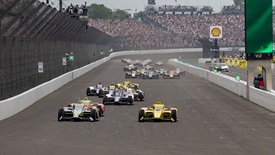
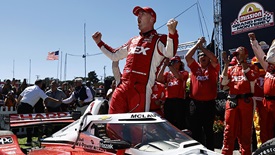
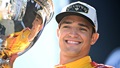
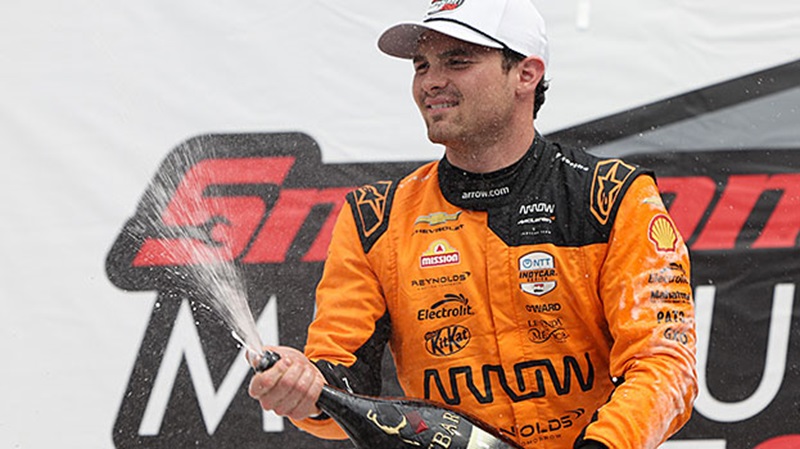
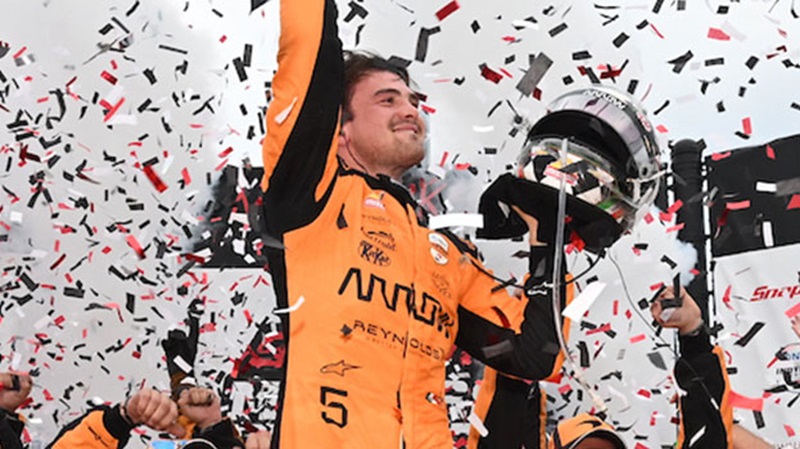
Rosenqvist earned his place on the Borg-Warner Trophy by winning the 110th Running of the Indianapolis 500 presented by Gainbridge on May 24. Driving the No. 60 SiriusXM Honda for Meyer Shank Racing w/Curb Agajanian, he made a daring move on the final lap, riding the high line against the wall exiting Turn 4 on Lap 200 and powering past David Malukas in the No. 12 Verizon Team Penske Chevrolet just yards before the Yard of Bricks start-finish line.
Rosenqvist won by .0233 of a second, the closest finish in Indianapolis 500 history. The race also featured a record-setting 70 lead changes. The victory came in Rosenqvist’s eighth Indianapolis 500 start, made him the 77th different winner of the race and earned him a record $4.34 million in prize money.
His victory initially took him on a media tour before the NTT INDYCAR SERIES returned to competition the following weekend on the streets of Detroit. With the season over, Rosenqvist said the trip to Tryon felt like “celebration 2.0.”
“It becomes more real now,” Rosenqvist said. “It’s one of those kind of victories that just always stays. No one’s ever going to be able to take it away from you, which I think is also why it’s such a relief to win this race, because we all dream about it, we all think about it, but we all know also how hard to win it.
“So, when you finally get it, it’s just like such a relief, and the fact that you also get imprinted on a trophy doesn’t hurt. Like, no one can undo what you did.”
Now, Rosenqvist is part of that history. He also brings a distinction no previous winner has brought to the trophy: He is the first Indianapolis 500 winner depicted with a full beard.
“That’s almost unbelievable,” Behrends said. “I mean, how can that happen? It’s just astounding.”
Behrends, who began sculpting drivers for the Borg-Warner Trophy in 1990, wanted the beard represented without making it the first feature people noticed.
“I had to kind of play around with the clay and figure out how I was going to do that, but I think we got it,” he said.
Rosenqvist found the distinction of being the first bearded driver on the Borg as crazy but believes he became a trendsetter.
“I think it’s the most mind-blowing fact because I feel like everyone has a beard,” Rosenqvist said. “Like, out of my friends, probably at least half of them have a beard.”
Six previous winners have been depicted with mustaches: Jules Goux (1913), René Thomas (1914), Gaston Chevrolet (1920), Wilbur Shaw (1937, 1939, 1940), Mauri Rose (1941, 1947, 1948) and Bobby Rahal (1986). None had a beard.
Behrends has sculpted two other Swedish Indianapolis 500 winners, 1999 winner Kenny Brack and 2022 winner Marcus Ericsson. American Josef Newgarden won back-to-back years in 2023 and 2024 while Spaniard Alex Palou won in 2025. Rosenqvist’s likeness gave him another opportunity to capture details that make each driver unique.
“One thing I like about his face, Felix has got a very strong jaw,” Behrends said. “He has a very Swedish jaw, so I like that. It’s a very strong, kind of angular face, a different-shaped face, by far, than Alex (Palou) or Josef’s (Newgarden), but very strong.
“Then he says: ‘I got his nose right. That’s a family nose.’ Apparently, his grandfather, father and now his daughter have that nose.”
Rosenqvist also noticed another detail Behrends captured: His right ear sits slightly higher than his left. He also was blown away seeing his likeness in three dimensions. That made the experience more personal than simply seeing his name on a trophy.
“I think the details are what make it come alive,” Rosenqvist said. “Because that’s literally what makes you, you. I think the cool thing was because we’ve all seen pictures of ourselves, but to see like a 3D version of yourself and to be able to look around and walk behind him, look out behind the ears and all the kind of things you never could do, it’s a little bit of an eerie experience.
“He’s definitely a pro, and he made it definitely worthy to be on the trophy.”
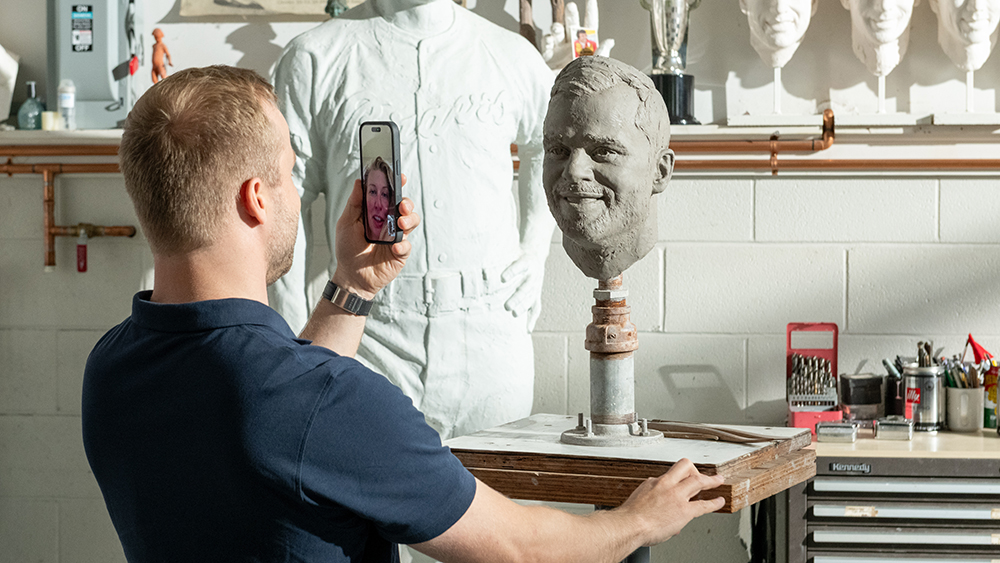
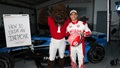
The significance extends beyond Rosenqvist himself. He and his wife, Emille, welcomed their first child, Stella, in May. Rosenqvist showed his likeness to his wife on a live phone video during the studio visit (photo, above).
Rosenqvist hopes his place on the Borg-Warner Trophy, which is housed daily at the Indianapolis Motor Speedway Hall of Fame Museum, will eventually become part of his family’s connection to the race.
“Maybe our grandkids will go check it out every now and then, or maybe it’ll be a tradition where we go to Indy if we don’t live there,” Rosenqvist said. “It’ll be a cool little family thing for us.
“Whatever happens, if my daughter or if I have a son in the future, or whatever happens, they decide to do something completely different, we always have that piece of history in our family to go back and say, ‘Hey, your grandpa did that,’ which is very rare to have that possibility. It’s very unique to have that opportunity.”
Photo credits: Scott R. LePage